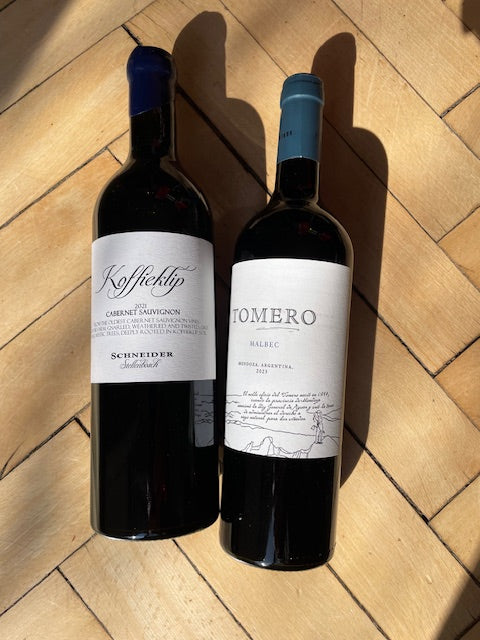
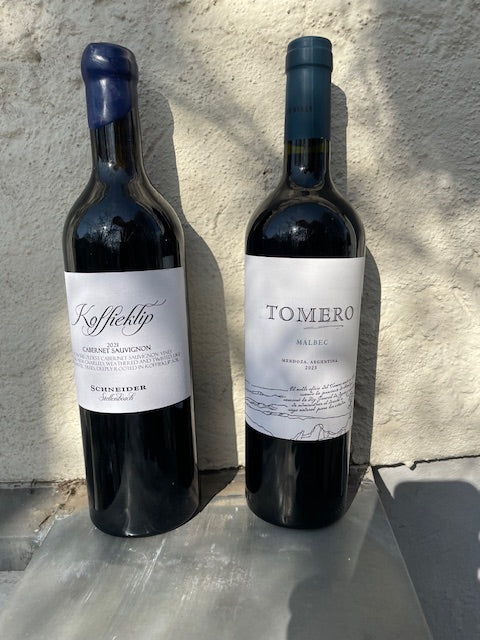
Cabernet Sauvignon and Malbec
Cabernet Sauvignon and Malbec
Couldn't load pickup availability
This offer is valid from March 26th to April 30th
Wines are best tasted side by side! This is the second pair I have selected. Two grape varieties originating from Bordeaux – both wines are vinified in an elegant style and are not too opulent. Both wines are oak-aged. Explore the following topics during your tasting at home:
- Fruit profile: Cabernet Sauvignon vs. Malbec – which fruit is more dominant and specifically reminds you of which fruit – in the bouquet as well as on the palate?
- Tannin structure: Firm and grippy (Cabernet) vs. soft and velvety (Malbec)? You can also choose terms like velvety, fine-grained, or even astringent or coarse-grained.
- Oak influence: Which wine shows more aging aromas? Which aromas are they in the nose and on the palate?
- Freshness vs. Opulence: How do the wines perform in terms of acidity and balance? Which wine has more acidity?
- Could you tell the grape varieties apart after the tasting?
🇿🇦 Koffieklip Cabernet Sauvignon 2021 (Kaapzicht, Stellenbosch)
- Stellenbosch is one of the best regions for Cabernet Sauvignon in South Africa.
- Koffieklip soils are granite soils weathered in the heat with a coffee-like coloring - (iron-rich, stony soils) often produce dense, spicy wines with dark fruit and a firm structure.
- Kaapzicht is known for elegant, well-balanced wines with a fine tannin structure.
🇩🇪 Markus Schneider Cabernet Sauvignon
- Markus Schneider is known for his modern, powerful style.
- His Cabernet Sauvignons are often fruit-forward, with juicy berry fruit, well-integrated spice, and softer tannins compared to classic Bordeaux styles.
- Interesting to see how it performs in comparison to its South African counterpart!
vs.
🇦🇷 Tomero Malbec 2023 (Bodegas Vistalba, Mendoza)
- Mendoza is THE stronghold for Malbec – high altitudes provide cool nights and preserve freshness in the wines.
- Malbec from there is often lush, with ripe plum, black cherry, violets, and a velvety tannin structure.
- Tomero comes from Vistalba, a top region within Mendoza:
the altitude of 1200 meters above sea level is typical for Mendoza and plays a major role in the freshness and acid structure of the wines. The soil is particularly exciting: alluvial terraces and the sandy-loamy soil create ideal conditions for the vines, especially in combination with the low nitrogen content, which gives the wines concentration and complexity.
The scree provides very good drainage, which helps, especially in hot years, to keep the vines from drying out too much - the water can quickly penetrate the soil and not evaporate. Mainly drip irrigation and furrow irrigation are used to optimally manage the water balance.
Share